The Map of Chinese Flavors
Deep Culture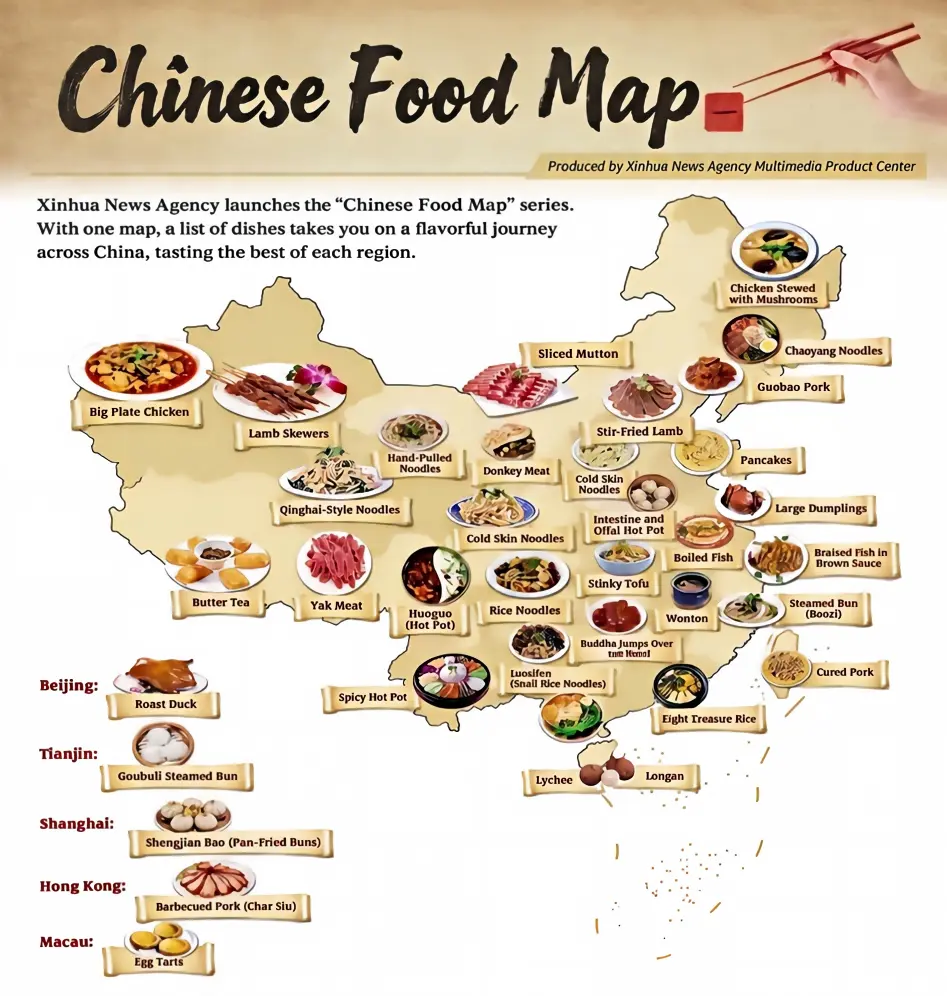
If you ask most foreigners what Chinese food is, they’ll say: fried rice, sweet and sour pork, spring rolls. Maybe Kung Pao chicken. That’s not Chinese food. That’s the Chinese food that traveled.
The real China is a map of flavors — one that shifts with every province, every river, every mountain range. To understand it, you have to look at geography, climate, and history.
Video: Understanding China's diverse culinary traditions.
The Four Pillars of Chinese Cuisine
Most Chinese people will tell you there are “four great cuisines”: Lu (Shandong), Chuan (Sichuan), Yue (Guangdong), and Huaiyang (Jiangsu). Some say eight. But the logic is the same: each region developed its own cooking tradition based on what grew there, what the climate allowed, and who passed through.
Lu (Shandong) The food of the north: hearty, salty, and built around wheat. Think dumplings, noodles, and braised dishes. Shandong is the birthplace of many classic techniques — roasting, simmering, and quick-frying.
Chuan (Sichuan) The fire of China. Chili, Sichuan peppercorn, garlic, and fermented beans. The flavor is not just “spicy” — it’s mala: numbing and hot. Sichuan food wakes you up.
Yue (Guangdong) Light, fresh, and ingredient-driven. Cantonese cooking is the art of not overcomplicating. Fresh fish, steamed chicken, delicate stir-fries. Dim sum is its most famous export, but the soul of Cantonese cooking is simplicity.
Huaiyang (Jiangsu) The elegant cuisine of the Yangtze Delta. Sweet, refined, and knife-skills heavy. This is the food of emperors. The flavors are subtle, the presentation is careful, and the ingredients are often from the river.
The North-South Divide
The biggest line on China’s food map is the Yangtze River.
North of the Yangtze, wheat dominates. Noodles, dumplings, steamed buns, and pancakes. The food is heavier, saltier, and designed to keep you warm in cold winters.
South of the Yangtze, rice rules. Rice is the daily staple. The food is lighter, fresher, and often sweeter. Steamed fish, stir-fried greens, and soups.
| North | South |
|---|---|
| Wheat | Rice |
| Dumplings | Rice noodles |
| Saltier | Sweeter |
| Heavy sauces | Light sauces |
| Lamb and pork | Pork and fish |
Read more: The Banquet of the Ba Kingdom →
The Sweet-Salty Border
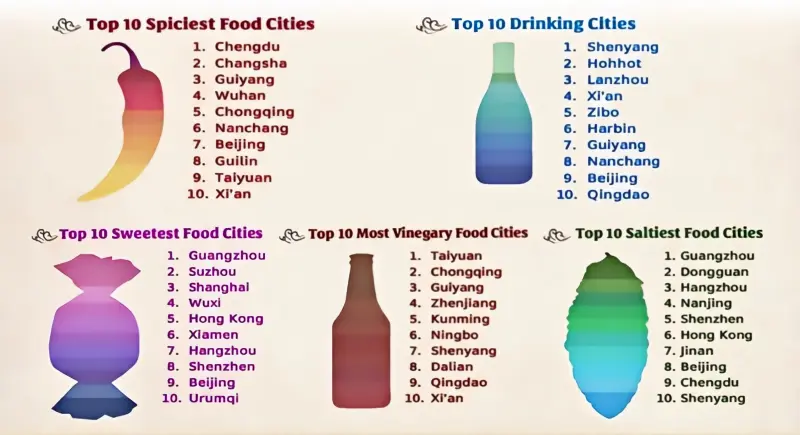
There’s a saying in Chinese food culture: “South is sweet, north is salty, east is sour, west is spicy.”
It’s not always accurate, but it points to something real.
The south (Guangdong, Jiangsu, Zhejiang) tends to use more sugar — braised dishes with caramelized sauce, sweetened soy, and sugar to balance salt.
The north (Shandong, Beijing) uses more salt and fermented bean paste. The food is bolder, more savory.
The west (Sichuan, Hunan, Guizhou) is the land of heat. Chili and pepper dominate.
The east (Jiangsu, Shanghai) leans slightly sour — vinegar is common in braised dishes and soups.
The Geography of Ingredients
Why is Sichuan spicy? Because the region is humid. Chili and Sichuan peppercorn help with the dampness.
Why is Cantonese food light? Because Guangdong is warm and close to the sea. Fresh ingredients don’t need heavy sauces.
Why is northern food wheat-based? Because wheat grows better in the dry, cold north than rice does.
Why is the east sweet? Because sugar cane grows in the warmer southern provinces, and the sugar trade influenced the region’s cooking.
A Food Map of China
If you look at a map of China and trace the cuisines, you’ll see the same patterns repeating:
- Coastal areas are seafood-heavy and use less oil.
- Inland areas rely on braising, stewing, and fermentation.
- Mountain regions use more preserved foods and herbs.
- Desert regions (like Xinjiang) use lamb and flatbreads.
What people eat is not random. It’s shaped by the environment over thousands of years.
One Thing That Connects
Despite all the differences, there’s one thing that connects every region: the idea of balance.
Not balance in the Western sense — not “healthy eating” — but balance in flavors: salty and sweet, hot and cold, fatty and fresh.
A Sichuan meal is balanced. A Cantonese meal is balanced. A northern dumpling meal is balanced. The way they achieve that balance is different, but the principle is the same.
Why This Matters for Travelers
If you travel to China and only eat what you already know, you’ll miss the point.
Chinese food is not one thing. It’s a map. And every region is a different place on that map.
Beijing is not Shanghai. Shanghai is not Chengdu. Chengdu is not Guangzhou.
If you want to understand China, eat your way across it. But don’t expect the same thing twice.
Story by YOGOTOCHINA
✦ Ready to explore China?
Find your tour →